
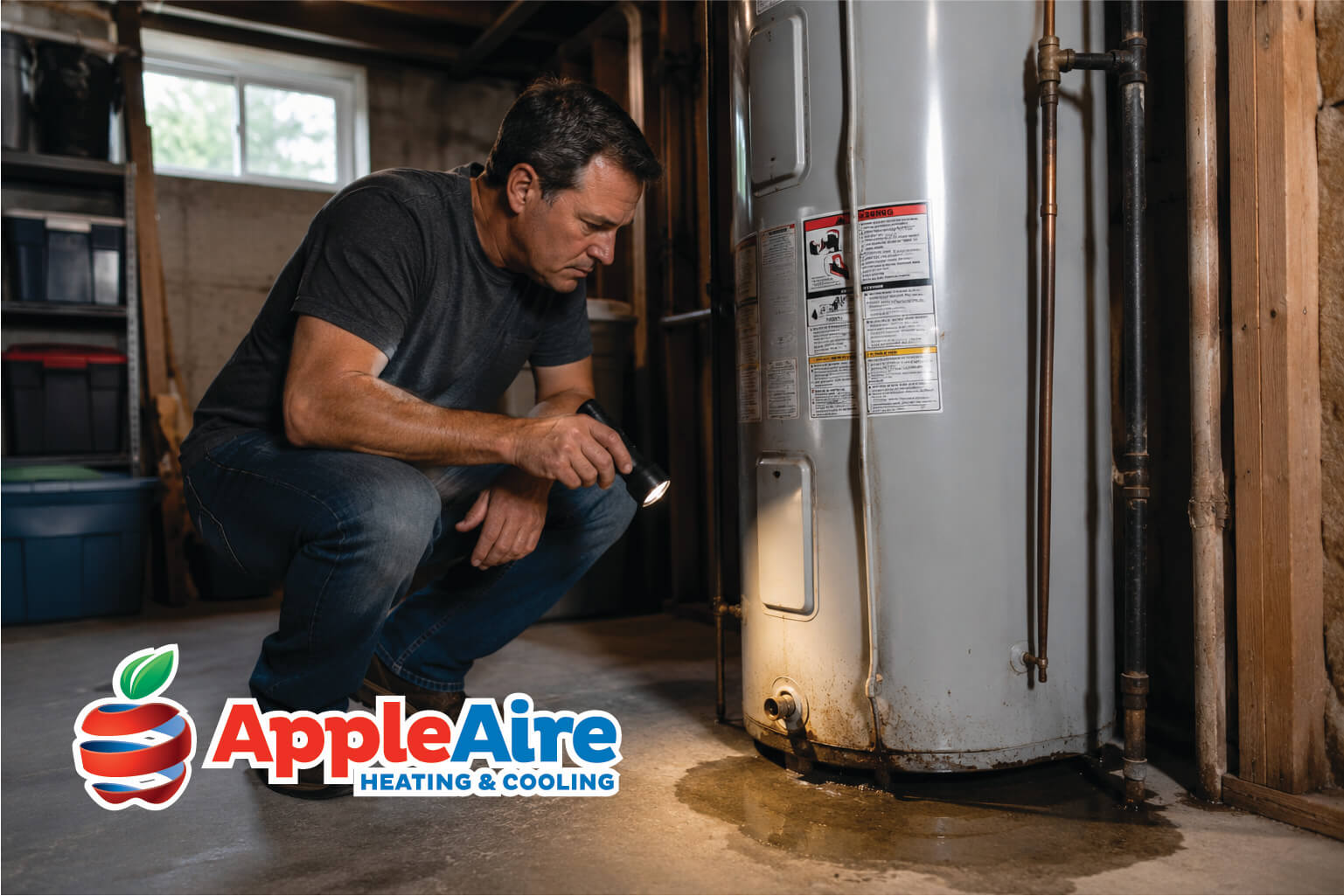
A water heater usually does not stop working without warning. Before it fails completely, you may notice less hot water, unusual noises, rusty water, corrosion, moisture around the tank, or repeated repair problems.
Not every symptom means you need a new water heater. A failed heating element, thermostat, valve, or other replaceable component may be repairable. However, when an older water heater develops a leaking tank or several problems at once, replacement is often the safer and more practical choice.
Here are the warning signs homeowners should take seriously.
1. Your Water Heater Is About 10 Years Old or Older
The age of the water heater does not automatically determine whether it needs to be replaced, but it provides important context.
Many traditional tank-style water heaters begin requiring closer attention after approximately 10 years. Their actual service life depends on the type of equipment, water quality, installation, maintenance, household demand, and operating conditions.
An older water heater that still provides dependable hot water and shows no signs of leaking may continue working. However, once an older unit begins leaking, corroding, producing unreliable hot water, or requiring frequent repairs, planning a replacement can help you avoid an unexpected loss of hot water or water damage.
You can often find the manufacture date on the equipment label or determine it from the serial number. A water-heater professional can help identify the age if the label is difficult to understand.
2. You Are Running Out of Hot Water Sooner
A noticeable reduction in hot-water capacity deserves attention, especially when your household’s water use has not changed.
Possible causes include:
- Sediment collecting inside a tank-style water heater
- A failed electric heating element
- A thermostat or control problem
- A damaged dip tube
- A burner or gas-control issue
- A water heater that is too small for the household
- General deterioration in an older system
Some of these problems can be repaired. Others may make replacement more sensible, depending on the water heater’s age, condition, repair history, and the cost of the work.
A professional diagnosis is important because a lack of hot water does not, by itself, prove that the entire water heater has failed.
3. The Water Heater Is Leaking
Water around the base of a water heater should never be ignored, but first you need to determine where it is coming from.
Water may be escaping from a plumbing connection, drain valve, temperature-and-pressure relief valve, or another repairable component. Moisture can also come from condensation or nearby plumbing.
A leak from the tank itself is different. Once the storage tank has corroded or developed a crack, it generally cannot be permanently repaired, and the water heater will need to be replaced.
Turn off the water heater and its water supply when it is safe to do so if you discover significant leaking. Keep away from standing water near electrical equipment, and contact a qualified professional promptly. A small leak can become a much larger one with little warning.
4. You See Corrosion on the Tank or Connections
Visible corrosion can indicate that moisture has been present around the water heater or its plumbing connections.
Look for rust, mineral deposits, staining, or deterioration around:
- The top water connections
- Valves and fittings
- The lower portion of the tank
- Seams in the tank jacket
- The drain valve
- The venting system on a fuel-fired water heater
Corroded plumbing connections may sometimes be repaired. Corrosion that appears to be coming through the body or seams of the tank is more concerning and may indicate that the tank is deteriorating.
Do not scrape, tighten, or disturb heavily corroded parts yourself. A weakened fitting can begin leaking when moved.
5. Your Hot Water Looks Rusty or Discolored
Discolored hot water can be related to the water heater, but it can also come from the home’s plumbing or the public water supply.
One useful observation is whether the discoloration appears in both the hot and cold water. When only the hot water is affected, the water heater becomes a more likely source. Internal corrosion, sediment, or deterioration of the anode rod may be involved.
If both hot and cold water are discolored, the cause may be elsewhere in the plumbing system or water supply.
Because water discoloration has several possible causes, the system should be inspected before deciding that replacement is necessary.
6. The Tank Is Popping, Rumbling, or Knocking
Popping and rumbling sounds in a tank-style water heater are often associated with sediment or mineral deposits at the bottom of the tank.
As the burner or heating elements warm the water, steam bubbles can form beneath or within those deposits, creating noise. Sediment may also reduce usable tank capacity and interfere with heat transfer.
Flushing may help some systems, but it is not always appropriate for an older tank that has not been maintained regularly. Disturbing heavy deposits in a weakened water heater could expose existing deterioration or contribute to leaking.
Have the condition evaluated before attempting to flush an older or heavily corroded unit.
7. The Water Temperature Is Unpredictable
Water that shifts from hot to lukewarm or becomes excessively hot may point to a control, thermostat, heating-element, burner, mixing, or capacity problem.
This can sometimes be repaired. However, inconsistent performance becomes a stronger argument for replacement when the water heater is older, has already needed repairs, or shows other signs of deterioration.
Water that is dangerously hot requires prompt attention because it can create a scalding risk.
8. The Water Heater Needs Frequent Repairs
One repair does not necessarily justify replacement. Repeated failures are different.
If you have recently paid for several service calls or the unit now has problems with multiple components, compare the expected repair cost with:
- The water heater’s age
- Its overall condition
- Its remaining expected service life
- The cost of replacement
- Warranty coverage on new equipment
- Potential efficiency improvements
- Whether the existing unit meets your household’s needs
Continuing to repair an aging tank may provide only a short-term solution when the tank itself is approaching failure.
9. Your Household No Longer Has Enough Hot Water
Sometimes the water heater is still operating as designed but no longer fits the household.
A growing family, larger bathtub, additional bathroom, new appliance, or changes in daily routines can increase hot-water demand. In that situation, replacing the system may improve comfort even though the existing water heater has not technically failed.
Proper sizing matters. Installing a larger tank is not always the only answer. Depending on the home, fuel source, space, electrical service, and hot-water needs, the options may include a different tank size, a high-recovery model, a heat-pump water heater, or a tankless system.
Should You Repair or Replace Your Water Heater?
Repair may make sense when the water heater is relatively young, the tank is sound, and the problem is limited to a replaceable component.
Replacement becomes more likely when:
- The tank itself is leaking
- Corrosion is coming through the tank body or seams
- The unit is around 10 years old or older and developing problems
- Hot-water performance remains unreliable
- Repair costs are becoming frequent or substantial
- The existing system no longer meets the household’s needs
- There are multiple warning signs at the same time
The best decision should be based on an inspection rather than age alone.
Is a Leaking Water Heater an Emergency?
A significant or active leak should be treated urgently because stored water can escape quickly and damage floors, walls, belongings, or nearby equipment.
When it is safe:
- Keep people away from standing water near electrical equipment.
- Shut off electrical power at the breaker for an electric water heater, but do not enter standing water to reach it.
- For a gas-fired unit, follow the manufacturer’s shutdown instructions or contact a professional.
- Close the cold-water supply valve to the heater if you can reach it safely.
- Call a qualified service company.
Call emergency services or the gas utility if you smell gas. Do not operate switches, use an open flame, or remain in the affected area.
Do Not Wait for a Small Warning Sign to Become a Flood
The best time to evaluate an aging water heater is before it fails completely.
At Apple Aire, we help homeowners in Wheat Ridge and throughout the Greater Denver area determine whether a water-heater problem can be repaired or whether replacement would be the safer long-term choice. We inspect the condition of the equipment, explain what we find, and help you compare the available options without assuming every problem requires a new system.
If your water heater is leaking, producing unreliable hot water, showing corrosion, or approaching the end of its service life, schedule an evaluation before the problem becomes more disruptive.